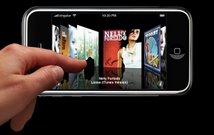
The problem is, if applications aren't easy to use, they won't have a future. The phone only has a limited amount of memory. In addition, too many unused applications will only make the phone harder to get around. "Novelty increases people's tolerance for unusable things," says Dave Yeats, a senior research scientist at Perceptive. "As they use it and the novelty wears off, some of these usability problems will start to be more irritating."
Even when an iPhone has the capability to do something, some applications tap that feature better than others--a situation that can vex some users. For instance, some applications are tuned to be exquisitely sensitive to the phone's accelerometer. Tilt the phone just a hair in some applications and a game character, for example, might go flying off the screen. Other applications, such as a free game called "Tilt Snake," aren't sensitive enough. "You had to almost hold your phone upside down and shake it to get the snake to turn," Yeats says.
The iPhone's original applications typically relied on the same cues for navigating through a program. Not so with the hundreds of newbie apps. "Things that were typically on the top would go to the bottom," Thornton says. "Now there is more variation out there."
Shortcuts are another thing Apple does well. For example, when a user pulls up the keyboard to type in a URL on their gadget, it includes a button marked ".com" that saves them four taps. "They just put themselves in the users' shoes to think about what the user is doing at a particular moment," Yeats says.
The solution, according to Thornton, is to study the applications Apple has crafted for the phone and to copy their structure. One of Apple's best tricks, Thornton says, is to use visual cues to help users figure out what to do next. For example, when a phone goes into sleep mode, an animated slider bar draws users' attention to what they have to do to wake the phone up.
"It's a simple thing like letting your user know where they are at all times," says Yeats. "When your screen is so small, you have to let users know where they are at all times."
And if you're lost on how to help your users find their way, just crack open one of Apple's applications and see how it does it.
Monday, September 1, 2008
How To Build A Great iPhone App - Forbes.com

Sunday, August 31, 2008
apple
An obituary for Apple Inc. CEO Steve Jobs was mistakenly published by Bloomberg News on Thursday, according to several reports.
The stock story detailing the death of the Cupertino, Calif.-based Apple (NASDAQ: AAPL) founder, who is still alive, appeared “momentarily” after a reporter had updated it, Bloomberg said. The incomplete obit was distinctly marked “Hold for release — Do not use,” the reports said
Following is the opening paragraph as it appeared on the Bloomberg wire:
“Steve Jobs, who helped make personal computers as easy to use as telephones, changed the way animated films are made, persuaded consumers to tune into digital music and refashioned the mobile phone, has XXXX. He was TK. Jobs XXXX, TK said XXXXX.”
Bloomberg, which was founded by New York Mayor Michael Bloomberg and prides itself on its accuracy and transparency, later published a note acknowledging the story's retraction on its wire.
“An incomplete story referencing Apple Inc. was inadvertently published by Bloomberg News at 4:27 p.m. New York time today,” the message read. “The item was never meant for publication and has been retracted.”
Monday, August 11, 2008
Apple hits 3 million iPhone's sold in its debut month - Aug. 11, 2008
"Talk about your summer scorchers.
One month after its debut, Apple's new iPhone has hit the 3 million sold mark, according to analyst Michael Cote of the Cote Collaborative.
'They are seeing unprecedented demand,' says Cote, adding that there appears to be no signs of a let up yet. Cote, a former T-Mobile executive, has been extremely accurate with wireless predictions in the past.
An Apple (AAPL, Fortune 500) spokesperson declined to comment on Cote's projections."
Friday, August 8, 2008
"Eight iPhone owners have joined an elite clan: Their gadget is running a program that cost nearly $1,000.
When the iPhone first hit the market in June 2007, those who paid the $499 entry price -- and signed the two-year AT&T contract -- owned a status symbol. A year later, we have the iPhone 3G, Apple Inc.'s speedier, sleeker and, most important, less expensive smart phone, which introduced a section for downloading third-party applications.
Now that the phone is affordable enough for a wider audience, a new status symbol has emerged: a seemingly useless application called I Am Rich.
Its function is exactly what the name implies: to alert people that you have money in the bank. I Am Rich was available for purchase from the phone's App Store for, get this, $999.99 -- the highest amount a developer can charge through the digital retailer, said Armin Heinrich, the program's developer."
Saturday, August 2, 2008

Tuesday, July 15, 2008
iphone
Apple - iPhone- 7/5/07
iPhone 3G combines three products in one - a revolutionary phone, a widescreen iPod, and a breakthrough Internet device. It features 3G, built-in GPS, ...www.apple.com/iphone/